
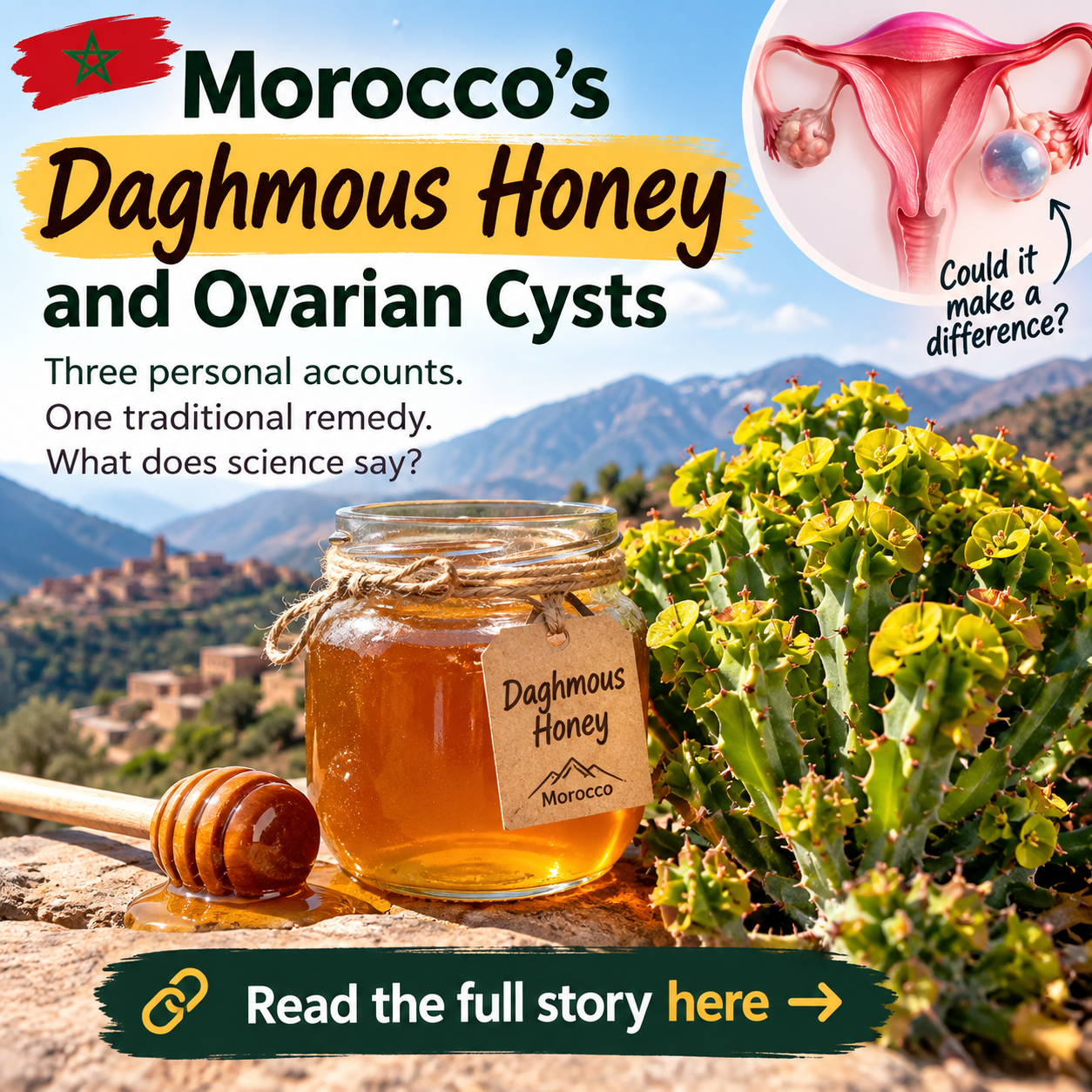
In the Atlas Mountains of Morocco, a distinctive honey known as daghmous honey has been treasured for generations. Produced by bees that collect nectar from the flowers of a native plant, this honey is closely associated with regions such as Azilal and Beni Mellal.
But daghmous is known for more than its place in Moroccan food traditions. The plant behind this honey, Euphorbia resinifera, has a long history of use in traditional Moroccan medicine, including reported uses involving ovarian and other reproductive-system cysts.
For some Moroccan families, this traditional knowledge is not simply something passed down through stories. It is connected to personal experiences that have raised questions about the possible medicinal properties of daghmous.
What does science actually say about this Moroccan plant? And how should we understand personal accounts of ovarian cysts disappearing after people used daghmous honey or preparations made from the plant?
To explore these questions, it is important to consider traditional knowledge, personal experiences, current scientific evidence, and safety.
What Is Moroccan Daghmous Honey?
Daghmous is the Moroccan name commonly associated with Euphorbia resinifera, a succulent, cactus-like plant native to parts of Morocco’s Atlas Mountains.
Despite its cactus-like appearance, daghmous belongs to the Euphorbiaceae family. The plant is particularly associated with the regions of Azilal and Beni Mellal, where it grows naturally and contributes to the local environment and beekeeping traditions.
When bees collect nectar from daghmous flowers, they produce honey valued for its distinctive characteristics. Moroccan consumers often recognize daghmous honey as a regional specialty.
Its reputation has also attracted scientific interest. Researchers have investigated the chemical composition and biological properties of daghmous honey, as well as compounds found in the plant itself.
However, one distinction is essential: honey produced from a plant is not chemically identical to the plant’s stems, roots, or milky latex. Findings about one preparation cannot automatically be applied to another.
This distinction becomes especially important when discussing traditional medicinal uses.
The Traditional Moroccan Connection Between Daghmous and Ovarian Cysts
Traditional plant knowledge varies across Morocco, and different communities may prepare or use the same plant in different ways.
A scientific review published in 2023 examined the ethnomedicinal uses, chemical composition, pharmacological properties, and toxicity of Euphorbia resinifera.
The review describes traditional medicinal practices in Morocco, including practices reported in the Atlas Mountains around Azilal and Beni Mellal. Among these reports are uses of daghmous preparations for conditions involving the female reproductive system, including cysts.
The review also describes traditional preparations involving different parts of the plant and, in some cases, honey.
These findings are significant because they show that the association between daghmous and reproductive-system cysts is documented in ethnobotanical literature. It is not merely a modern claim circulating on social media.
Nevertheless, documentation of a traditional remedy is not the same as proof that it works.
The review does not establish that daghmous honey cures ovarian cysts, nor does it provide clinical evidence demonstrating that a particular daghmous preparation reliably makes cysts disappear.
Instead, it identifies a traditional practice that deserves careful scientific investigation.
Personal Experiences That Raised Questions
Beyond published research, personal experiences have contributed to interest in daghmous among some Moroccan families.
One account concerns a woman who had been diagnosed with ovarian cysts and breast lumps. According to her family’s account, her doctor recommended surgery.
She subsequently used a traditional preparation consisting of a very small amount of dried, ground daghmous stem mixed with daghmous honey.
Less than a month later, follow-up medical examinations reportedly showed that the previously identified cysts and breast lumps had disappeared.
The reported outcome surprised the family and prompted questions about whether the traditional preparation could have played a role.
Two additional accounts described similar experiences involving ovarian cysts. In these cases, the individuals’ conditions were reportedly reassessed through medical examinations, and the cysts were said to have disappeared.
These accounts are personal reports rather than published clinical case studies. The medical records have not been independently reviewed, and the precise diagnoses and clinical circumstances are not available for scientific assessment.
For that reason, they cannot establish that daghmous caused the reported outcomes.
However, personal experiences can sometimes generate useful research questions. When similar outcomes are reported by different people, researchers may have reason to investigate whether a shared exposure deserves closer examination.
The next step is not to assume that the remedy works, but to determine whether a reproducible effect exists and whether the preparation can be used safely.
Can Ovarian Cysts Disappear on Their Own?
Understanding ovarian cysts is essential when evaluating claims about any traditional remedy.
Ovarian cysts are fluid-filled sacs in or on an ovary. They vary in size, appearance, cause, and clinical significance.
Some cysts are functional cysts associated with the normal menstrual cycle. According to the American College of Obstetricians and Gynecologists, many of these cysts disappear on their own within one or two menstrual cycles.
Other ovarian cysts may persist, grow, cause symptoms, or require further evaluation or treatment. Their management depends on factors such as their appearance on ultrasound, size, symptoms, and the patient’s individual circumstances.
This variation matters when interpreting personal experiences.
If a cyst disappears after someone has consumed a traditional preparation, the disappearance is an observation worth documenting. But the timing alone cannot establish whether the preparation caused the change.
To investigate a possible treatment effect, researchers would need reliable information about the original diagnosis, the type of cyst, the preparation used, the timing of follow-up examinations, and the results.
Comparisons with what would normally happen without the treatment would also be necessary.
Such evidence would help determine whether the reported outcomes occur more often than expected.
What Scientific Studies Have Found About Daghmous
Research on Euphorbia resinifera has examined several aspects of the plant, including its chemical constituents and biological activities.
Studies have investigated extracts and compounds associated with antioxidant, antimicrobial, anti-inflammatory, and other effects in laboratory or preclinical settings.
Researchers have also studied Moroccan daghmous honey for certain biological properties, including antimicrobial activity under laboratory conditions.
These findings provide information about the substances present in the honey and plant, but they do not demonstrate that either product treats ovarian cysts in humans.
A laboratory result cannot automatically be translated into a medical benefit. A compound may show biological activity in a test tube but have a different effect when consumed, absorbed, metabolized, or exposed to human tissues.
For ovarian cysts specifically, convincing evidence would require studies designed to determine whether a clearly defined preparation produces a meaningful and reproducible clinical benefit.
At present, the scientific review discussed above documents traditional uses but does not establish daghmous honey as an effective treatment for ovarian cysts.
This distinction is important for anyone interested in exploring the subject responsibly.
Daghmous Honey Is Not the Same as Dried Daghmous Stem
One of the most important details in traditional daghmous preparations is the difference between the honey and the plant itself.
Daghmous honey is produced by bees from floral nectar. Dried daghmous stems are plant material with a different chemical composition.
The plant’s milky latex contains biologically active compounds, including resiniferatoxin, that can cause intense irritation and other harmful effects. The plant’s toxicity makes it particularly important not to assume that a traditional preparation is safe simply because it has been used historically.
Mixing ground plant material with honey does not establish that the mixture is safe to swallow.
For this reason, personal accounts involving dried daghmous stems should not be interpreted as instructions for preparing or consuming a remedy. No safe or effective oral dose for treating ovarian cysts has been established by adequate clinical evidence.
People interested in daghmous should distinguish ordinary food honey from preparations containing the plant itself and should seek qualified medical advice before considering medicinal use.
Why Further Research Could Be Valuable
Traditional medicinal knowledge can provide researchers with starting points for investigating plants and their possible biological effects.
In the case of daghmous, several questions deserve further examination.
First, researchers would need to distinguish between the effects of daghmous honey and those of extracts or preparations made from the plant.
Second, they would need to identify the relevant chemical constituents and investigate their biological effects using appropriate laboratory methods.
Third, toxicological studies would need to establish the risks associated with different preparations and routes of exposure.
Finally, only carefully designed human studies could determine whether a particular preparation is safe and effective for a clearly defined medical condition.
Such research would help distinguish between a traditional use, a promising laboratory finding, and a treatment supported by clinical evidence.
It could also help prevent the unsafe use of plant preparations whose composition and toxicity are not well understood.
A Moroccan Tradition Worth Understanding
Daghmous occupies a distinctive place in Morocco’s botanical and cultural landscape. Its honey is associated with the Atlas Mountains, particularly the regions around Azilal and Beni Mellal, while the plant itself has been described in scientific literature examining Moroccan traditional medicine.
Personal accounts involving ovarian cysts have encouraged some families to ask whether daghmous may have medicinal properties that researchers have not yet adequately investigated.
Those accounts should neither be treated as definitive proof of a cure nor dismissed without consideration. They are observations that can help formulate questions for further investigation, provided their limitations are clearly acknowledged.
The central question remains open: could a particular daghmous preparation have a clinically meaningful effect on certain ovarian cysts, and could that effect be demonstrated without exposing people to unacceptable risks?
Answering that question will require careful research, reliable clinical documentation, and a clear understanding of the differences between honey and the potentially toxic plant itself.
Until adequate evidence becomes available, daghmous honey should not be presented as a proven treatment for ovarian cysts. Anyone diagnosed with an ovarian cyst should follow appropriate medical advice and recommended monitoring rather than replacing medical care with an unproven remedy.
The value of traditional knowledge lies not in assuming that every traditional treatment works, but in identifying questions that deserve serious investigation.
Morocco’s daghmous tradition offers one such question.
Scientific References
1. Ethnomedicinal Use, Phytochemistry, Pharmacology, and Toxicology of Euphorbia resinifera O. Berg. (B): A Review.
Journal of Zoological and Botanical Gardens, 2023.
This review discusses the traditional uses of daghmous in Morocco, its chemical constituents, reported biological activities, and the need for further research into its safety and effectiveness.
2. American College of Obstetricians and Gynecologists: Ovarian Cysts.
This medical resource explains different types of ovarian cysts, their evaluation, and why many functional cysts disappear without treatment.
3. Scientific Research on Moroccan Daghmous Honey.
Research has investigated the biological properties of honey associated with Euphorbia resinifera. Laboratory findings should not be interpreted as proof that daghmous honey treats ovarian cysts in humans.
Medical Disclaimer
This article is for educational and informational purposes only. It does not provide medical advice, diagnose a condition, or recommend daghmous honey or plant preparations as a treatment for ovarian cysts.
Daghmous plant material can contain toxic compounds. Do not ingest dried daghmous stems, latex, or homemade preparations as a treatment. If you have been diagnosed with an ovarian cyst, consult a qualified healthcare professional about appropriate evaluation, monitoring, and treatment.

